Best overall: Royal Caribbean. Best for Disney-centered family routines: Disney Cruise Line. Best for sensory-tool support: Carnival Cruise Line. This 2026 guide compares autism friendly cruise lines by their published support resources and the questions you need answered before choosing a ship.
- Royal Caribbean leads this autism friendly cruise lines shortlist for its published autism-specific support program.
- Disney Cruise Line suits families who want Disney activities, but character encounters and shows require sensory planning.
- Carnival Cruise Line partners with KultureCity; sensory tools do not replace a quiet-space plan.
- Confirm accommodations for your ship and sailing, including support for autistic adults, before committing.
Why this matters
A cruise line's accessibility program is a starting point, not a description of your entire trip. Boarding queues, announcements, dining rooms, unfamiliar bathrooms, and port transfers each deserve a separate decision.
The best cruise is the one whose daily conditions match your needs—not the one with the longest activity list. If you want help turning those needs into a travel plan, La Frontera Travels provides accessible, sensory-friendly travel planning for travelers with disabilities or sensory sensitivities and their families.
For 2026, assess the actual ship and itinerary alongside the cruise line. A useful accommodation at boarding does not resolve an unsuitable cabin location or an exhausting port day.
What makes the best autism friendly cruise lines?
Use these criteria before comparing entertainment or destinations:
- Autism-specific resources: Look for written guidance that addresses sensory and communication needs, rather than relying on a general accessibility label.
- Predictable daily routines: Check dining arrangements, activity schedules, and how staff communicate changes.
- Sensory recovery: Identify where you can withdraw from noise, crowds, bright lighting, or social demands.
- Individual accommodations: Ask what the line can arrange for your specific needs and what requires advance notice.
- Age-appropriate support: Confirm arrangements for the traveler’s age. A children's program does not establish support for autistic adults.
- Ship-level confirmation: Separate published fleet information from arrangements confirmed for your sailing.
Treat a nonnegotiable need as a screening condition. If a required food arrangement or safe cabin setup remains unresolved, the ship does not become suitable because its entertainment looks appealing.
Autism-friendly cruise lines at a glance
These recommendations compare support approaches, not clinical outcomes. None of the options guarantees a low-stimulation environment throughout the ship.
| Cruise line | Best for | Standout resource | Key limitation |
|---|---|---|---|
| Royal Caribbean | Families seeking autism-specific planning resources | Published Autism Friendly program | Ship activities and shared spaces still need individual screening |
| Disney Cruise Line | Families who want Disney-centered routines | Disability planning resources and youth-club open-house periods | Characters, music, shows, and queues need deliberate sensory planning |
| Carnival Cruise Line | Travelers who benefit from sensory tools | KultureCity partnership and sensory bags | Tools do not remove environmental noise or provide individual supervision |
1. Royal Caribbean: best overall for autism-specific planning
Royal Caribbean is the strongest starting point on this shortlist because it publishes an Autism Friendly program. Its autism-related resources describe support such as priority check-in, boarding and departure, dietary accommodations, and autism-friendly activities.
Royal Caribbean is the best starting point for families comparing autism-specific cruise support. Use the program to frame your questions, then confirm which arrangements apply to your chosen ship and traveler.
Royal Caribbean pros
- Autism-specific guidance gives you more concrete questions to ask before choosing a sailing.
- Published priority procedures address transitions that deserve advance planning.
- Dietary support provides a route for discussing food requirements before departure.
- Autism-friendly activity resources give you alternatives to assessing the general schedule alone.
Royal Caribbean cons
- The program does not make every public space quiet or every activity suitable.
- Published resources do not establish individual supervision for your traveler.
- A ship's attractions still need screening for sound, lighting, queues, and recovery options.
Best for: Families who want an autism-specific planning framework and are ready to assess the ship around it.
For a 2026 sailing, ask how boarding assistance is requested, where you should report, and how the process works for your party. For dining, describe the requirement precisely: a familiar food is different from an allergy accommodation, and both need clear communication.
Ask separately about youth-program participation, toileting assistance, and adult support when relevant. Do not treat a general statement about inclusion as confirmation of hands-on assistance.
Verdict: Buy—choose Royal Caribbean when its confirmed arrangements meet your nonnegotiable needs.
2. Disney Cruise Line: best for Disney-centered family routines
Disney Cruise Line belongs on this shortlist for families who actively want Disney characters, storytelling, and entertainment. Its disability planning resources and youth-club open-house periods offer ways to prepare for parts of the onboard experience.
The distinction matters: Disney interest and sensory suitability are separate questions. A traveler can love a character and still dislike the sound, crowding, or uncertainty surrounding an encounter.
Disney Cruise Line pros
- Familiar stories and characters give interested travelers concrete material for trip preparation.
- Youth-club open-house periods offer opportunities to explore spaces together.
- Published disability resources help organize accommodation questions before departure.
Disney Cruise Line cons
- Character encounters and entertainment need their own sensory assessment.
- Youth spaces have participation rules; do not assume individual assistance.
- A Disney-focused itinerary is a poor fit when the traveler does not enjoy its central experiences.
Best for: Families whose traveler enjoys Disney and benefits from previewing activities and spaces.
Build a short list of experiences the traveler actually wants. Ask about entry procedures, sound and lighting effects, whether leaving is straightforward, and whether returning is permitted. An attraction is optional even when it is a major reason other families choose the ship.
For your 2026 plan, make a quiet evening a valid alternative to a show. Avoid presenting every scheduled activity as something the family must complete together.
Verdict: Buy—choose Disney Cruise Line for genuine Disney interest, not as a substitute for sensory screening.
3. Carnival Cruise Line: best for sensory-tool support
Carnival Cruise Line partners with KultureCity on sensory inclusion and offers sensory bags containing tools intended to help guests manage sensory input. That makes Carnival relevant when portable supports are part of your traveler’s established coping routine.
A sensory bag is an aid, not an environmental change. Assess the cabin, dining arrangements, entertainment, and routes around the ship separately.
Carnival Cruise Line pros
- The KultureCity partnership provides a specific sensory-support resource to ask about.
- Sensory bags add an onboard support option beyond your personal packing list.
- A named program makes predeparture questions more focused than a general request for a sensory-friendly trip.
Carnival Cruise Line cons
- Sensory tools do not silence announcements, music, or other guests.
- A program partnership does not establish a dedicated quiet room on your ship.
- Sensory support does not include personal care or individual supervision by default.
Best for: Travelers who benefit from portable sensory tools and have a separate plan for retreating from stimulation.
Ask how the sensory-bag process works on your sailing and what the bag contains. Bring the traveler’s familiar essentials rather than making an unfamiliar onboard item the sole support for an important need.
For a 2026 Carnival sailing, give cabin placement and daily pacing the same attention as the sensory program. A useful tool cannot make an unsuitable schedule suitable.
Verdict: Buy—choose Carnival Cruise Line when sensory tools complement a ship and itinerary that already fit.
How these cruise lines rank
Royal Caribbean ranks first for its explicit autism-specific planning framework. Disney Cruise Line takes a distinct slot for families seeking Disney experiences, while Carnival Cruise Line earns its place through its KultureCity sensory-support resources.
This ranking uses the criteria above: published resources, routine, sensory recovery, individual accommodations, age suitability, and ship-level confirmation. It is not a claim that every ship was inspected or that one line suits every autistic traveler.
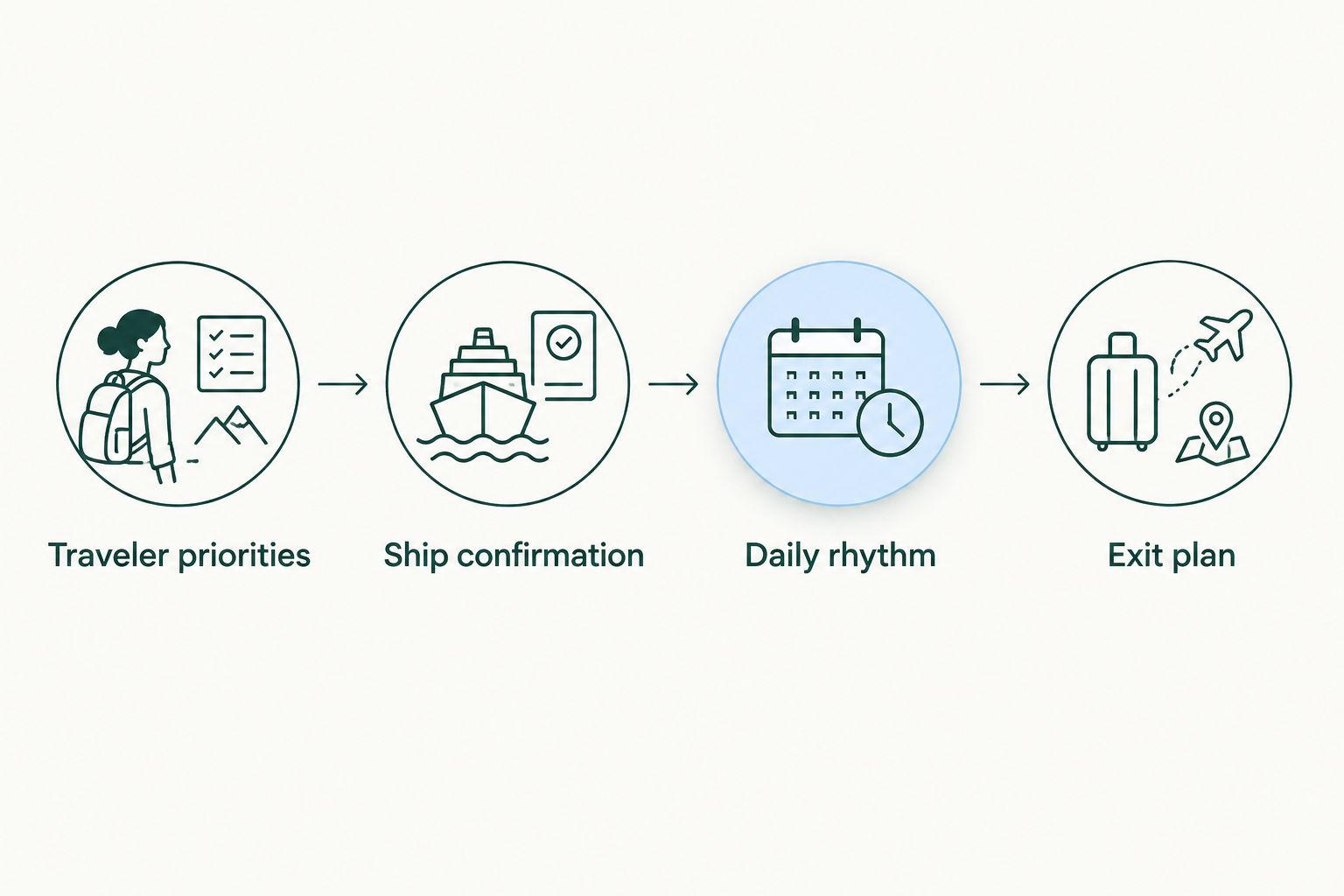
Turn the shortlist into a workable cruise plan
A useful comparison ends with written questions for your actual sailing. Organize the decision around the traveler rather than trying to fit the traveler into the ship's schedule.
Traveler priorities
Create a 1-page traveler summary with communication preferences, sensory triggers, food requirements, personal-care needs, and helpful responses to distress. Include preferences the traveler identifies, not just observations from companions.
Separate essentials from preferences. A step-free route, a particular food requirement, and a wish for a quieter dining table require different checks.
Ship confirmation
Send focused questions to the cruise line's accessibility team. Ask about the process, location, and limitations of each requested accommodation; keep the response with your travel documents.
Replace “Is the ship autism-friendly?” with questions staff can answer directly:
- Where should you report for the agreed boarding arrangement?
- What help is provided during youth-program participation?
- How are dining requirements communicated onboard?
- What is the procedure if the assigned arrangement does not match the confirmation?
Daily rhythm
Start with 1 primary outing per port day as a planning limit, then adjust to the traveler’s preferences. Leave room to return early without treating the day as unsuccessful.
Add 2 planned quiet breaks per day to your draft schedule. These are starting points, not clinical recommendations; change them to match the traveler rather than enforcing the numbers.
Exit plan
Before entering a show, restaurant, or excursion, decide how you will leave if needed. Clarify who accompanies the traveler and where the group will reconnect.
For shore excursions, ask about transport, walking surfaces, waiting periods, bathroom access, and returning early. A quiet destination does not establish a suitable journey there.
La Frontera Travels provides accessible, sensory-friendly travel planning for families who want help shaping these decisions around the traveler. Keep the same priorities visible through ship selection, accommodation requests, and daily planning.
Plan around your sensory needs
Explore accessible, sensory-friendly travel planning for your family.
Which autism-friendly cruise line should you choose?
Start with Royal Caribbean if you are undecided. Its autism-specific resources give you the clearest starting framework on this shortlist, but your essential requirements still decide whether to proceed.
Choose Disney Cruise Line when Disney experiences are a genuine priority. Choose Carnival Cruise Line when portable sensory support fits the traveler’s needs and the wider sailing passes your checks.
For 2026, reject any option that leaves a nonnegotiable unanswered. La Frontera Travels' accessible, sensory-friendly travel planning centers the traveler rather than the length of the activity schedule.
FAQ
What's the best autism-friendly cruise line for families?
Royal Caribbean is the best starting point on this shortlist because it publishes an Autism Friendly program. Confirm the arrangements for your ship, sailing, and traveler before choosing it.
Is Disney Cruise Line better than Royal Caribbean for an autistic child?
Disney Cruise Line is the better fit when Disney experiences are a central preference; Royal Caribbean leads this shortlist for autism-specific planning resources. Neither choice removes the need to assess sensory conditions and participation rules.
Does Carnival Cruise Line offer sensory support?
Carnival Cruise Line partners with KultureCity and offers sensory bags. Ask about the process for your sailing, and bring familiar personal tools rather than depending entirely on onboard items.
Are autism-friendly cruises suitable for autistic adults?
Suitability for autistic adults depends on the individual traveler and the confirmed arrangements. Ask about adult needs directly rather than assuming a children's program extends to adult services.
Can cruise staff provide one-to-one support for my child?
Do not assume cruise staff provide one-to-one support. Ask specifically about supervision, personal care, toileting, and program participation, and arrange any required support before travel.
How do I choose a cabin for sensory needs?
Choose a cabin by checking its position against nearby entertainment, public spaces, and service areas on the deck plan. Ask about the location, but do not treat any cabin as guaranteed silent.
What should I confirm before choosing a cruise in 2026?
Confirm every nonnegotiable accommodation for the actual ship and sailing. Prioritize boarding, food, communication, personal care, cabin suitability, and a workable exit plan.
One last thing
Plan the first evening as carefully as the headline excursion. Arrival, boarding, finding the cabin, and learning unfamiliar routes already make a substantial transition.
Keep that evening's commitments optional. La Frontera Travels' sensory-friendly travel planning is most useful when comfort and participation—not completing the schedule—define a successful trip.